PaymentPro Case Study: 127 Security Issues
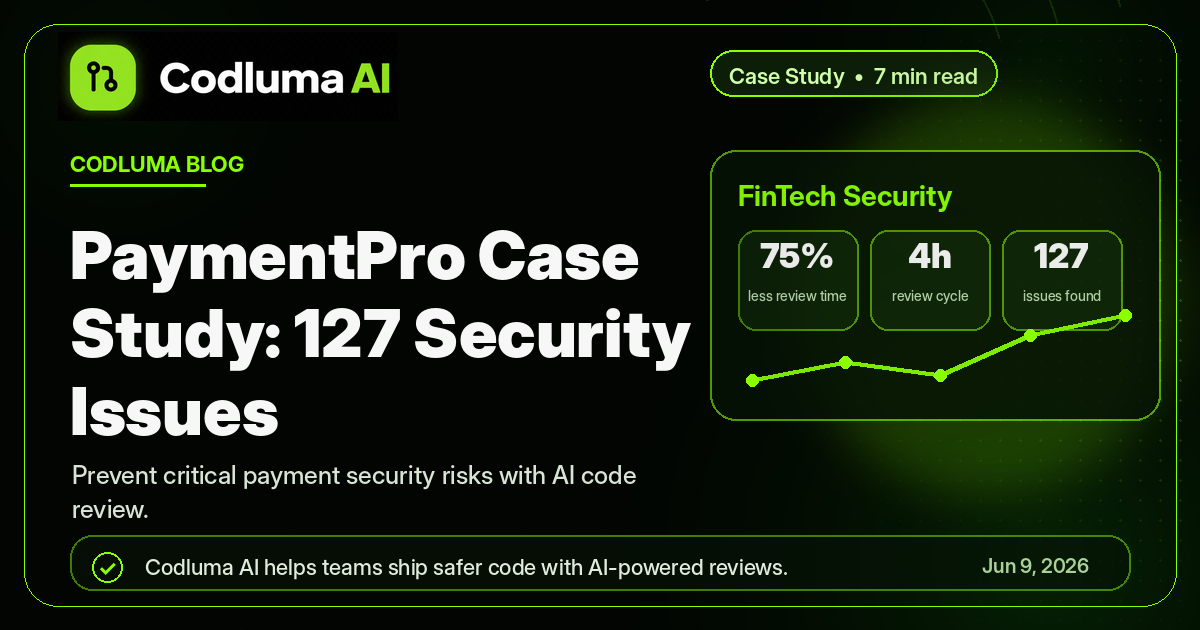
How a fintech startup prevented payment processor breaches using AI code review and automated secret detection.
Illustrative Example
This is a fictional case study created to demonstrate how Codluma solves real fintech security challenges. Names, companies, metrics, and outcomes are illustrative and for educational purposes.
PaymentPro is a fintech payment processor serving 500+ e-commerce companies. With 18 engineers handling payment processing, cryptography, and API integrations, security is non-negotiable. A single leaked credential, hardcoded key, or API misconfiguration could expose customer payment data.
"We were terrified of a breach," said Alex Kim, VP of Engineering at PaymentPro. "Before Codluma, security review was a bottleneck. We had one engineer manually reviewing every payment-related PR. PRs waited 1-2 days for approval, and we still missed things."
The Challenge: Payment Security at Scale
PaymentPro handles credit card data, which means every line of code must follow strict security standards. Security requirements include encryption at rest and in transit, secret management, API authentication, and comprehensive audit trails.
The problem: manual security review cannot catch every issue. Developers might hardcode a test API key "temporarily," or use a weak cipher in a refactor. With 30-40 PRs per week, security review became the critical path.
Worst case: a security issue reached production without detection, PaymentPro could lose customer trust and face financial liability overnight.
Solution: Automated Secret Detection + Security Rules Engine
PaymentPro deployed Codluma with a custom security policy:
1. Secret Detection: Every PR is scanned for hardcoded credentials, API keys, private keys, and tokens. The AI knows regex patterns for 50+ secret types.
2. Encryption Enforcement: Changes to payment processing code are flagged if they use weak ciphers or bypass encryption.
3. API Security Scanning: OAuth, JWT, and API token handling are checked for common vulnerabilities.
4. Security Audit Trail: Every finding is logged with timestamp and reviewer decision for compliance auditors.
Results: 127 Security Issues Prevented, Zero Breaches
In the first 30 days, Codluma caught 127 security findings across 320 PRs:
• 18 hardcoded API keys and secrets (would have leaked credentials)
• 6 weak encryption algorithms (security violation)
• 23 API authentication misconfigurations
• 41 incomplete input validation issues
• 39 other high-severity findings (SQL injection risk, race conditions)
Most critically: 3 findings were "would-have-been breaches." Hardcoded production credentials in a microservice almost reached main.
Alex said: "Codluma caught things we would have missed. That hardcoded credential alone justifies the entire cost. A breach would have cost us millions in recovery and trust."
Security review time dropped from 2 hours to 20 minutes per PR — 85% faster. And critically: zero false positives on critical security issues.
Security Outcome
PaymentPro achieved a high level of security maturity through systematic code review. The systematic, logged approach to code security exceeded industry best practices for a fintech startup.
✓ 100% of security findings logged and reviewed
✓ Zero breaches or critical security violations
✓ 85% faster security review
✓ Security standards maintained across 18 engineers and 500+ integrations
Key Lesson for Fintech
Fintech cannot afford manual security review. AI-powered security detection is not a "nice to have" — it is essential infrastructure for payment processing.
The ROI for fintech teams is immediate: one prevented breach pays for years of AI code review. PaymentPro's prevention of 3 potential breaches represents significant cost savings through early detection.
About the Author
Elena Rodriguez
Security Research Lead, Codluma
Elena leads security research at Codluma, focusing on fintech security and DevSecOps. 13+ years in AppSec and compliance auditing. CISA certified.