Detecting Authorization Regressions in Pull Requests
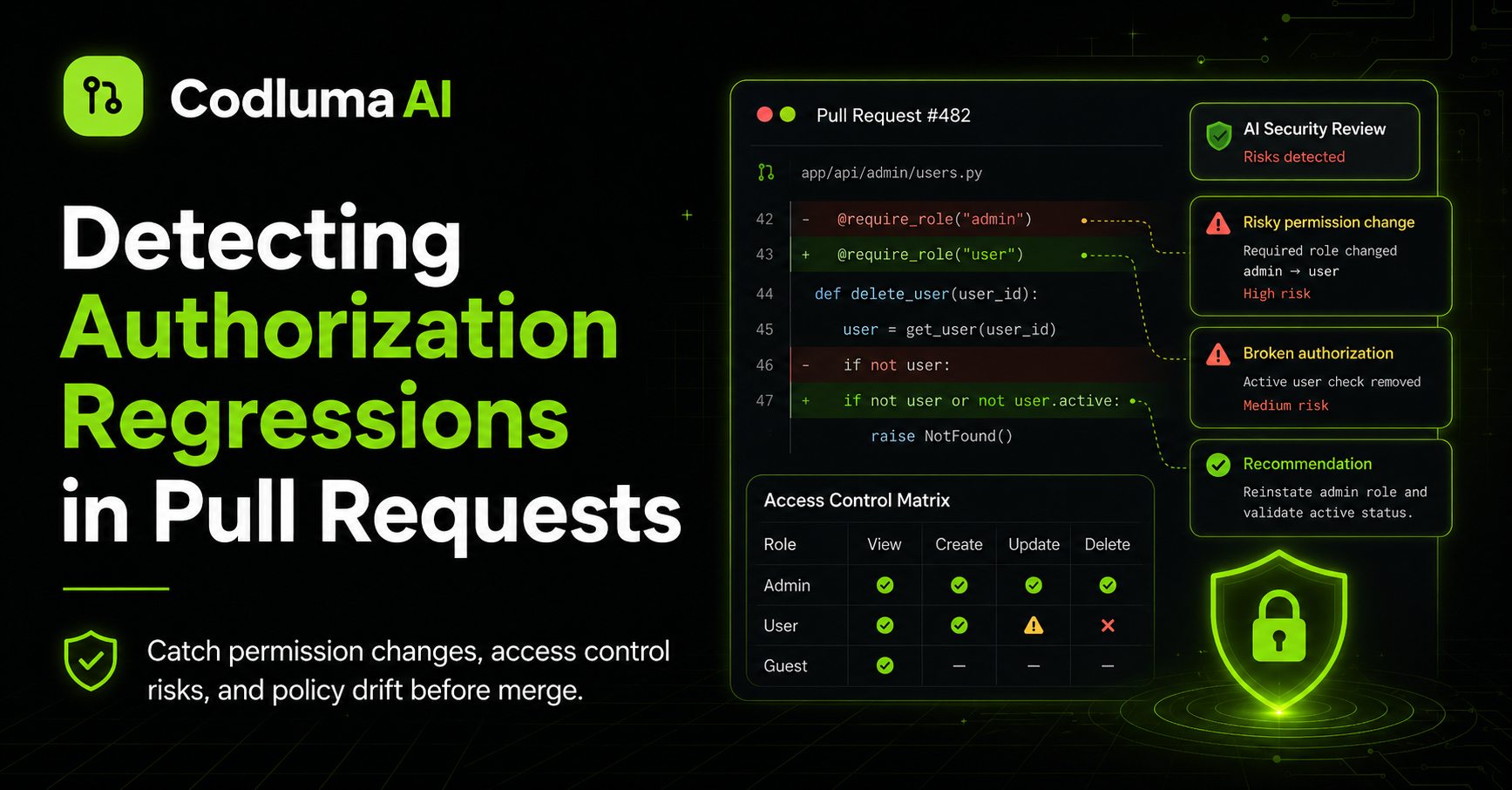
How to catch broken permission checks before they reach production. Authorization bypass patterns AI review detects automatically.
Authorization bugs are insidious: code reviews often miss them because they require understanding the entire permission model, not just reading the changed lines.
Pattern 1: Missing Permission Check
A function should verify that the user has permission before executing an action. If the permission check is deleted or commented out, it's a serious vulnerability.
AI detection: Looks for deleted permission checks, changes that reduce authorization scope, or removed security decorators.
Pattern 2: Hardcoded Bypass
A developer adds a condition like "if (user.id == 123) { return success }" to bypass auth for testing, then forgets to remove it.
AI detection: Scans for hardcoded user IDs, comments mentioning bypass, or conditional auth logic.
Pattern 3: Elevated Privileges
A function runs with higher privileges than necessary (running as admin when user permission would suffice).
AI detection: Compares privilege levels before/after the PR, flags unnecessary elevation.
Pattern 4: Unvalidated User Input in Auth Logic
Auth logic uses unsanitized user input (e.g., "if (request.role == userRole")). An attacker can manipulate the role.
AI detection: Identifies where auth decisions depend on user-controlled input without validation.
Best Practice
Pair AI review with human security review for auth changes. AI catches patterns; humans catch logic flows.
About the Author
Marcus Webb
Chief Security Officer, Codluma
Marcus leads security strategy at Codluma. 15+ years in cybersecurity and compliance. Board advisor for security-focused startups.