Reviewing Python Code with AI: Common Patterns & Fixes
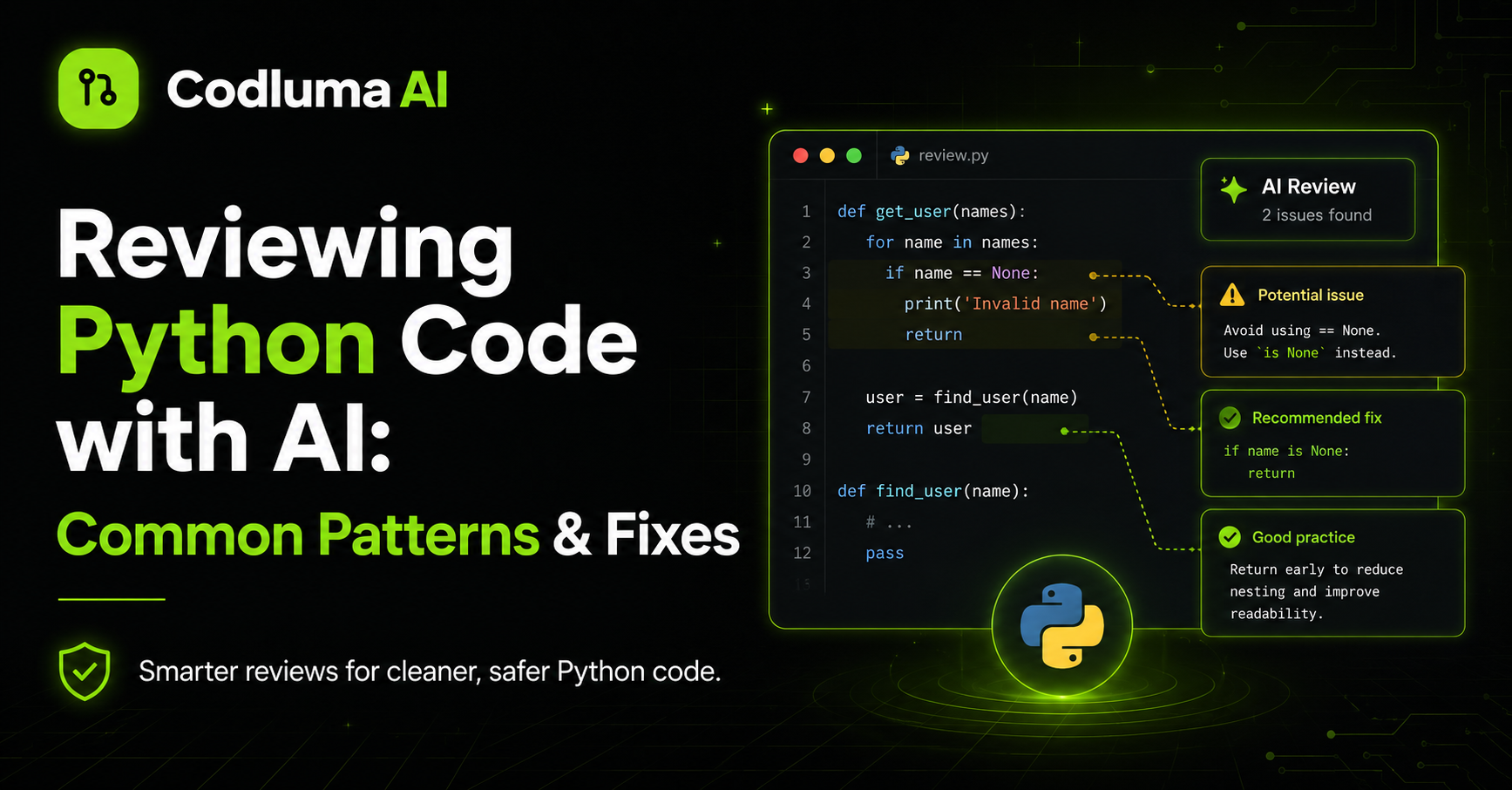
Discover the most common Python code patterns that AI review catches: type errors, null dereferences, unsafe dependencies, and asyncio mistakes.
Python's flexibility makes code review critical—many errors only surface at runtime. AI code review can catch these patterns automatically, leaving human reviewers to focus on architecture and business logic.
Pattern 1: Missing None Checks
Python developers often forget that functions can return None. A common error: accessing an attribute on a result that might be None.
AI review detects: method calls on possibly-None values, dictionary lookups without defaults, and chained calls that could fail.
Fix: Use type hints (Optional[Type]) and explicit None checks before use.
Pattern 2: Async/Await Mistakes
Forgetting to await an async function is a silent bug—the code runs but doesn't do what you expect.
AI review detects: unawaited coroutines, mixing sync and async code, and missing event loop setup.
Fix: Always await async calls; use type hints to mark async functions clearly.
Pattern 3: Unsafe Dependency Updates
Outdated dependencies introduce security risks. Codluma checks every PR for new CVEs in dependencies.
Fix: Pin dependency versions, review changelogs before updating, and run tests against new versions.
About the Author
Alex Chen
Staff Engineer, Codluma
Alex leads AI code review training at Codluma. 12+ years building Python infrastructure at scale. Core contributor to major Python security tools.