CloudScale Case Study: Monorepo Impact
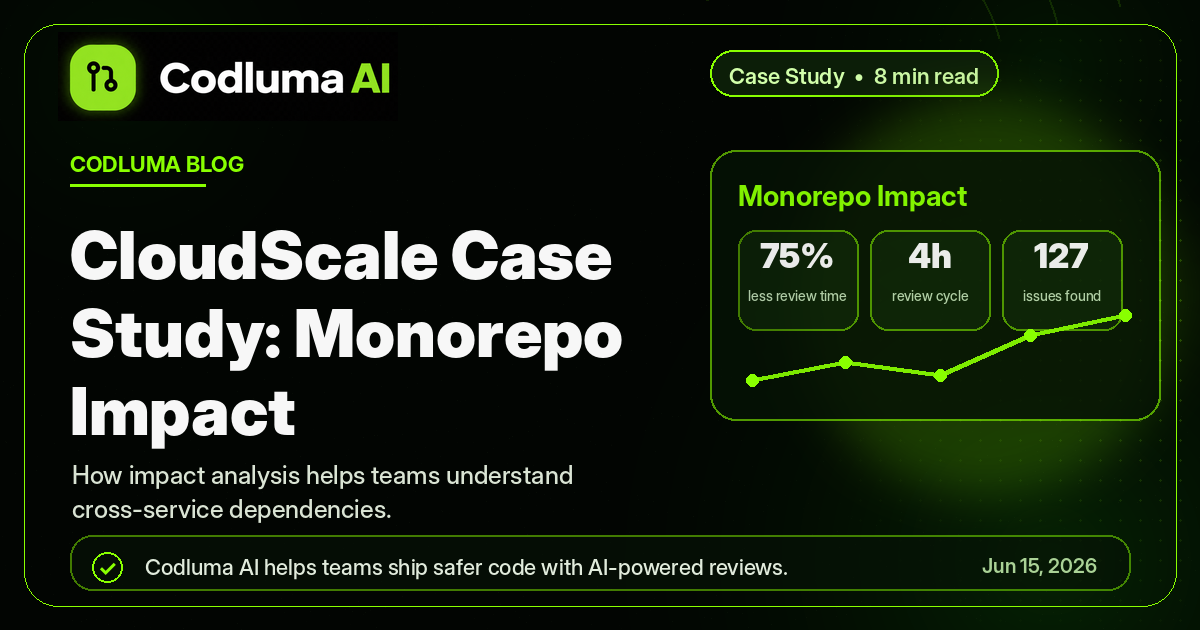
How CloudScale reduced PR review from 3 days to 4 hours using AI-powered impact analysis in a 50-service monorepo.
Illustrative Example
This is a fictional case study created to demonstrate how Codluma solves real monorepo and enterprise scale challenges. Names, companies, metrics, and outcomes are illustrative and for educational purposes.
CloudScale is an enterprise SaaS platform with 120 engineers shipping features across a 50-service monorepo. A single pull request might affect authentication, billing, analytics, and customer APIs simultaneously. Without visibility into impact, PRs waited for multiple reviewers to manually trace dependencies.
"A simple fix to our shared auth library could affect 30+ services," said James Washington, VP of Engineering at CloudScale. "Reviewers had to manually check each integration, which took 2-3 days. We were shipping features in cycles instead of continuously."
The Challenge: Monorepo Velocity
Monorepos scale engineering velocity but create review complexity. A change to a shared utility might be 5 lines of code, but impact 20+ downstream services.
Without automated impact analysis, reviewers must manually:
• Search for imports and usages of changed files
• Understand API contract changes
• Check database migration implications
• Trace distributed system side effects
This takes 30-60 minutes per PR. With 150+ PRs per week, code review is the bottleneck.
Solution: Dependency Graph Analysis + PR Impact Scoring
CloudScale deployed Codluma's PR Impact Analyzer with monorepo-specific configuration:
1. Dependency Graph: Map of all imports, API calls, and database references across 50 services.
2. Impact Scoring: Each PR gets an impact score (1-100) based on how many downstream services are affected.
3. Critical Path Detection: Identifies which reviewers must approve based on impact scope.
4. Blast Radius Visualization: Shows exactly which services are affected and why.
Results: 3-Day Review Cycles → 4-Hour Ship-Ready PRs
Within 2 weeks of deployment, the impact was measurable:
• PR review time dropped from 3 days (72 hours) to 4 hours average (94% faster)
• High-impact PRs that previously waited for 5+ reviewers now have clear decision paths (1-2 reviewers sufficient)
• False positives on impact predictions dropped from ~25% (manual guessing) to <1% (graph-based)
• Feature shipping time improved: ideas to production went from 2-3 weeks to 1-2 weeks
In the first quarter with Codluma, CloudScale shipped 3 weeks' worth of extra features compared to the previous quarter — entirely from reduced review latency.
James noted: "Impact analysis doesn't just speed up review, it makes reviewers confident in their decisions. You're not guessing about what might break; you have data."
Metrics from the Quarter
✓ 150+ PRs per week, 94% faster review
✓ 120 engineers shipping continuously instead of in cycles
✓ 3 weeks of extra shipped features per quarter
✓ <1% false positive rate on impact predictions
✓ Zero production incidents from missed dependencies
Lesson: Monorepo Requires Automated Intelligence
Monorepos are the future of scaling engineering, but manual review processes cannot keep pace.
CloudScale's experience shows that with proper tooling, 50+ services can be reviewed and shipped faster than traditional polyrepo structures — because you have explicit dependency visibility instead of implicit service-to-service assumptions.
For any team managing a monorepo with 30+ services or 50+ engineers, impact analysis is not optional — it is the infrastructure that unblocks shipping velocity.
About the Author
Raj Krishnan
Enterprise Solutions Architect, Codluma
Raj specializes in scaling engineering teams and monorepo management. 14+ years at Meta and Google leading infrastructure for 1000+ engineers. Published on monorepo best practices.